“No camera” and privacy: what robot vacuum sensors collect
“No camera” says which sensors are on board, not which data leave the robot. This guide separates navigation, obstacle recognition, app and servers, and shows what the listings declare and what they do not.
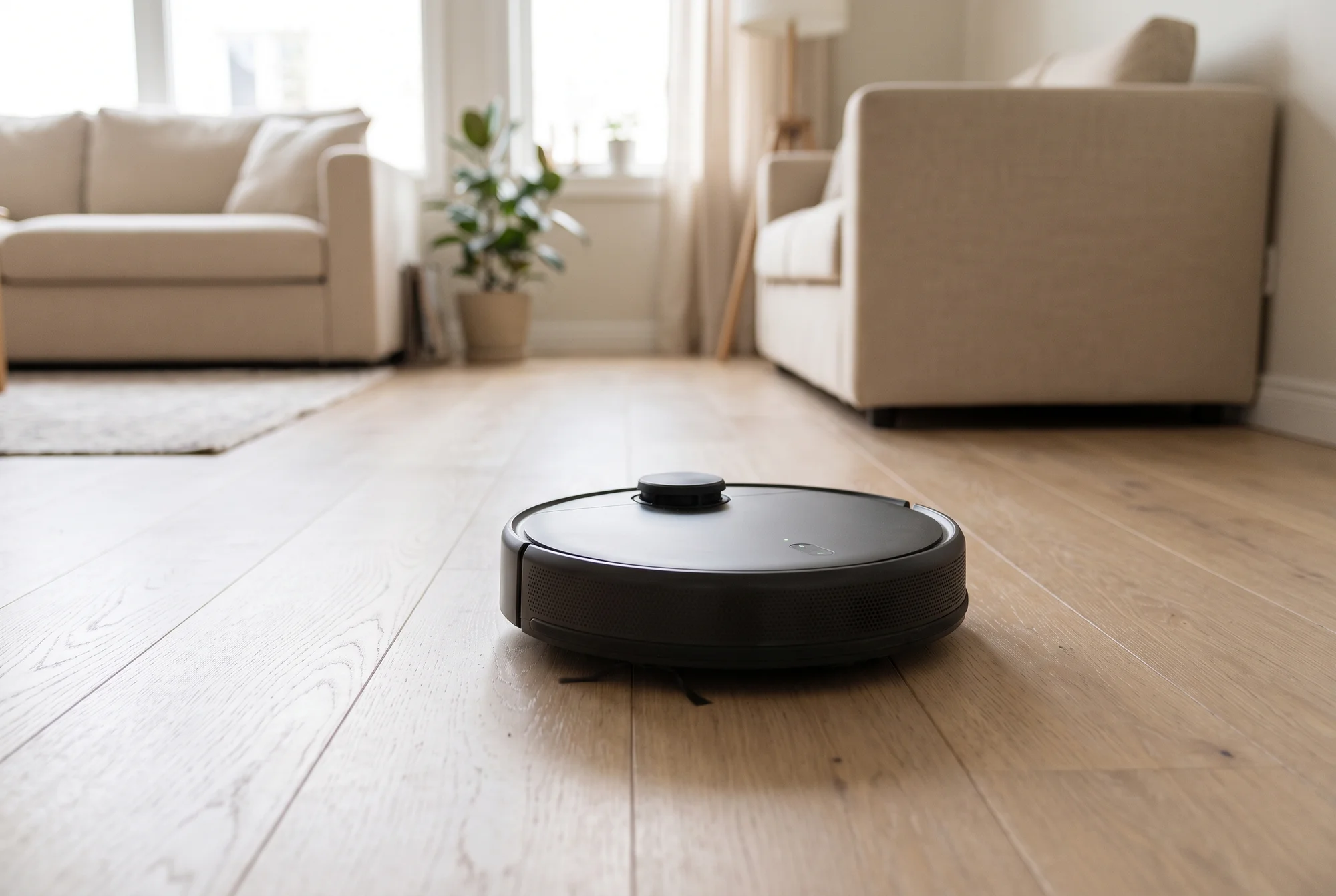
“No camera, so no privacy problem” is a line that turns up often in robot vacuum reviews. The first half is a spec-sheet fact; the second half is a conclusion, and it does not follow automatically from the first. A camera is a sensor. Privacy is about what the robot produces, where it processes it and where it sends it.
Three families of sensors, three kinds of information
LiDAR. This is the laser sensor that measures the distance to walls in order to draw the map of the home. In the listings it appears as “rotating LiDAR” or, on some recent models, “solid-state LiDAR”. It does not produce images: it produces a floor plan, with rooms and obstacles.
3D time-of-flight sensors and structured light. They measure the distance to obstacles in front of the robot. These too return geometry, not photographs.
Camera. It is the only one of the three that can produce images. In the listings, obstacle recognition appears as “camera with AI recognition”. Some models also declare a microphone, live video from the app and two-way audio.
So “no camera” rules out images from the robot, but not the map of the home, not the microphone and not the usage data that passes through the app.
What the listings declare
The information below comes from the manufacturers' data that we hold in the catalogue. The site has not tested the robots and has not verified what they actually transmit.
Camera declared absent. Roborock Q7 L5 detects obstacles only on contact with the bumper, declares no microphone and lists servers in the European Union. iRobot Roomba Plus 515 Combo has the same pattern (bumper, no camera, no microphone), but its declared servers are “multiple regions”. Dreame D20 declares no camera, no microphone and servers in the European Union, plus operation without a connection. Ecovacs DEEBOT T30e OMNI uses structured light, has no camera and declares servers in multiple regions. That it can be used without registering an account is a separate fact, and the listing reports it separately.
Camera declared present. Roborock Saros 20 declares a camera and a microphone, recognition processed on board the robot, live video from the app and servers in the European Union. Among its protections it lists remote video switched off until activated, confirmation on the robot, a password in the app and a microphone that can be turned off. Ecovacs DEEBOT X11 OmniCyclone declares a camera, a microphone, on-board processing, live video, confirmation on the robot as a protection and a voice assistant that relies on a cloud language model; its servers are in multiple regions. Dreame X50 Ultra Complete declares a camera, a microphone, live video, two-way audio and an indicator light during transmission; its servers are in the European Union. Narwal Freo Z10 Ultra declares a camera and a microphone and servers in multiple regions, but does not say where the processing happens.
Not declared. On the listings for Xiaomi Robot Vacuum X20 Max and Xiaomi Robot Vacuum X20+ the presence of a camera and a microphone is not stated: the manufacturer does not declare it in the data we collected. They declare structured light for obstacles, but that allows no conclusion either that a camera is there or that it is not.
The same difference shows up in the comparisons: Roborock Q7 L5 versus Roborock Saros 20 puts a bumper-only model next to one with a camera, a microphone and protections; Dreame D20 versus Dreame X50 Ultra Complete does the same within one brand.
The microphone and the voice
The microphone is a separate item from the camera. There are models with a declared camera and microphone, like the Saros 20 and the X50, and models with neither. Voice assistants also appear in the listings: on the Saros 20 commands are recognised on board, on the Ecovacs X11 the assistant uses a language model in the cloud. These are two different situations as far as where the voice travels, even though in both cases the listing speaks of a “voice assistant”.
Where the data goes
The listing carries three useful entries: where obstacle recognition is processed (on board the robot, or not declared), which servers are declared (European Union or multiple regions) and whether use requires an account. What the listings do not say matters just as much: how long data are kept, whether maps can be deleted by the manufacturer, who has access to them. That information sits in the manufacturer's privacy notice, not in our data, so the site does not report it.
How to read a listing
- Camera: yes, no and not declared are three distinct cases.
- Microphone: to be checked separately, even when the camera is absent.
- Processing: “on board” and “not declared” are not equivalent.
- Servers: “European Union” and “multiple regions” describe two different perimeters.
- Protections: indicator light, confirmation on the robot, password and video off by default are declared only on some models.
- Offline operation and use without an account: shown only where the manufacturer declares them.
A robot with LiDAR and no camera still has a map of the home in the app. A robot with a camera that processes on board and keeps video off until activated has a different risk surface from one that streams live. Neither case comes down to a single word on a listing.