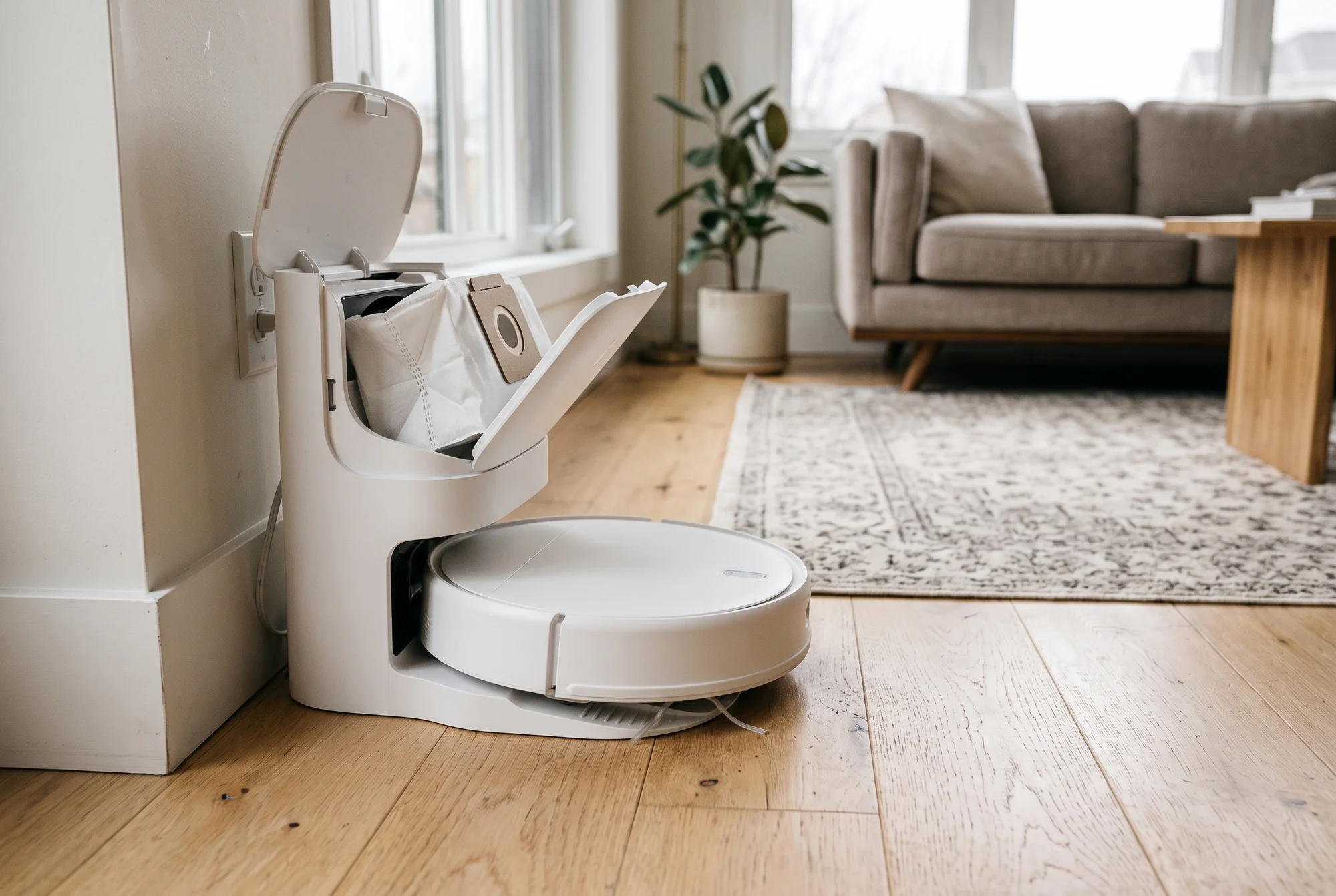
How many Pa does a robot vacuum need?
Pascals are the most prominent number on robot vacuum listings, yet no standard makes them comparable across brands. This guide explains what they say, what they don't and which data to read next to them.
On a robot vacuum's box, the biggest number is almost always suction, expressed in Pa. But the question “how many do I need?” has a problem upstream: the number doesn't measure the same thing from one brand to the next, and the CobotCompare catalogue shows it well.
What Pa are
Pa stands for pascal, the unit in which the manufacturer declares the robot's suction. It is a figure declared by the manufacturer, not one we measured: the site has not tested the robots and does not give scores.
The key point is this: there is no shared standard for measuring it. Each brand chooses how to measure, and the result carries the same name, “Pa”. A higher number does not mean “sucks harder” when the two robots come from different makers, and the value does not say how much dust ends up in the bin on your floor.
The numbers in our catalogue
The listings report the declared suction power. A few examples, all manufacturer declarations:
- eufy C10: 4000 Pa; vacuums only, no mopping.
- Xiaomi Robot Vacuum X20+: 6000 Pa, in the same price band as the eufy C10, with spinning-disc mopping and a base that empties, washes and dries the pads.
- Roborock Q7 L5: 8000 Pa, an entry-level model with a dragged mop pad and no pressure.
- Dreame X50 Ultra Complete: 20000 Pa.
- Roborock Saros 20: 36000 Pa.
Looking at the list, it is tempting to conclude that the Saros 20 has nine times the suction of the C10. The data does not support that: these are figures declared by different brands, with measurement methods the listings do not report. Even between two robots from the same brand, such as the Q7 L5 and the Saros 20, the gap between 8000 and 36000 Pa goes with a difference in generation and price band, not with a cleaning ratio on the floor that anyone has measured.
What really changes between two robots
Here is an example from our data: the comparison of the Dreame X50 Ultra Complete and the Roborock Saros 20 shows 20000 against 36000 Pa. The differences the site measures between the two are others: days between base emptyings (100 against 65), robot height (89 mm against 79.8 mm) and climbable threshold (42 mm against 45 mm). These are data that affect specific tasks, such as passing under a low piece of furniture or crossing a door threshold.
Which data to read next to Pa
To understand what a robot will do at home, these listing fields can be read on their own and do not depend on a measurement convention:
Carpet behaviour. The listings say whether the robot recognises the carpet, raises suction, lifts the mop or avoids it. The Saros 20 raises suction, lifts the mop and can avoid the carpet; the Q7 L5 recognises the carpet and raises suction. On a carpet the declared strategy counts, beyond the figure.
Brush and anti-tangle. The type of main brush and the declared anti-tangle feature say how the robot is built for hair and pet fur. The Dreame X50 Ultra Complete declares two rubber rollers.
Bin and base capacity. The Q7 L5's bin is 400 ml; the Dreame X50 Ultra Complete's base bag is 3.2 litres and the declared interval between two emptyings is 100 days. These are numbers that translate into upkeep.
Height and thresholds. A robot 99 mm tall, like the Q7 L5, and one 79.8 mm tall, like the Saros 20, do not fit under the same furniture. The figure is measurable and depends on no convention.
Battery and runtime. Capacity in mAh and declared minutes say how much surface can be covered on one charge. For the Dreame X50 Ultra Complete the manufacturer declares 220 minutes with a 6400 mAh battery.
So how many Pa are needed
The honest answer is that no Pa threshold guarantees a result, because the number is not comparable across brands and does not describe floor cleaning. For people with carpets and pets, the carpet behaviour and brush fields say more than the peak value. For people with low furniture, height matters. For people who don't want to deal with upkeep, the days between emptyings matter.
The number has one reasonable use: comparing robots from the same maker, within the same range, knowing that it indicates the generation and not a cleaning ratio. For the rest, the robot's listing and the comparisons between two models show, next to Pa, the data that change everyday use.
Where the manufacturer does not declare a figure, the listing leaves it empty rather than estimating it: a dash in the table reads as “not declared”, not as “zero”.
Moving up a price band
Moving up a band almost always brings higher Pa, but also different navigation, obstacle recognition and more complete bases. The comparison of the Roborock Q7 L5 and the Roborock Saros 20 shows it: the Q7 L5 has no camera and detects obstacles only through its contact bumper; the Saros 20 has a 3D time-of-flight sensor and a camera with recognition processed on the robot itself. That, more than the 28000 Pa gap, changes what the robot can do in a room full of objects.
Pa remain useful as a reminder of what to read next to them: carpets, brush, height, upkeep. These are the fields of our listings from which an informed choice starts.